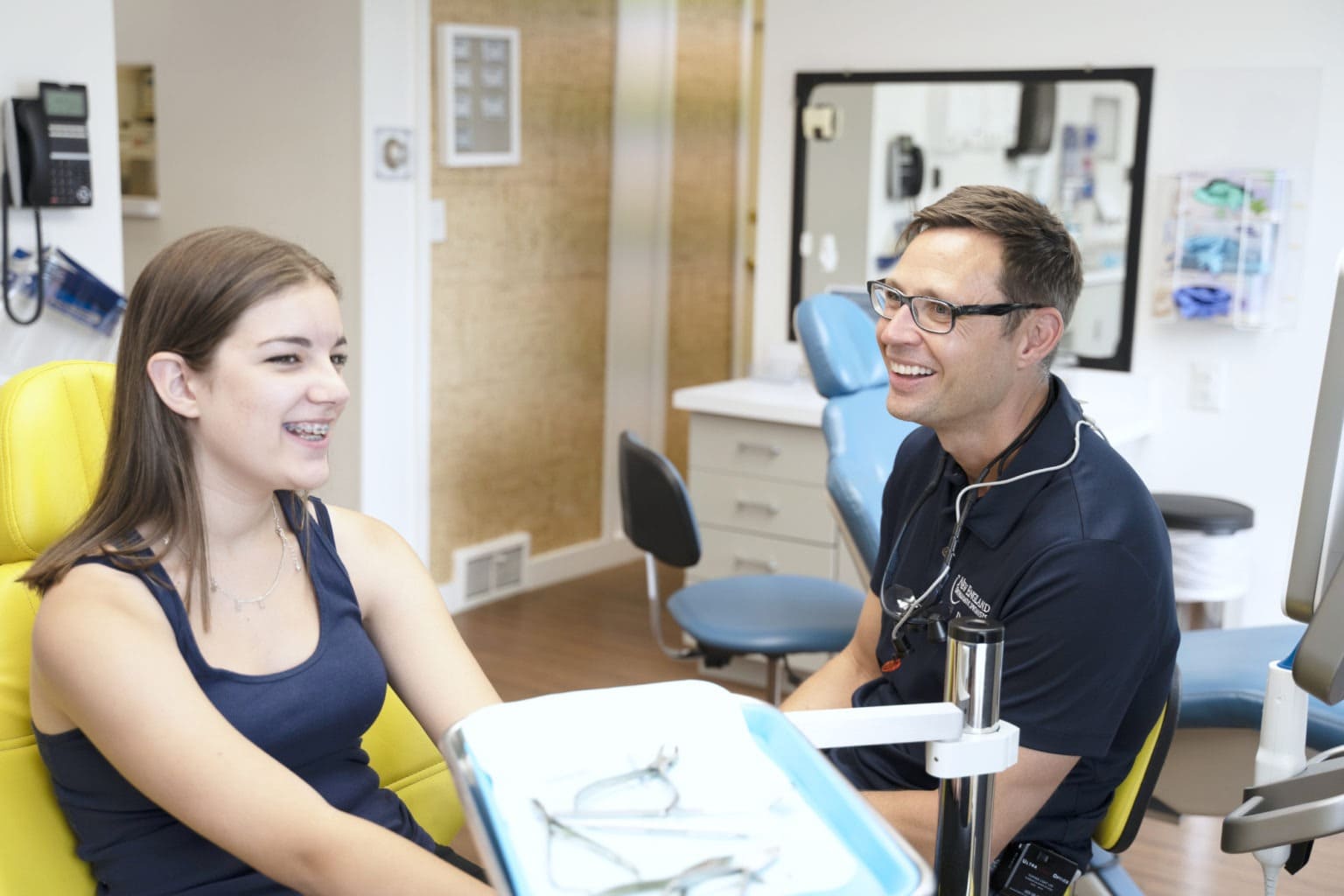
A palatal expander is an orthodontic appliance that widens the upper jaw by applying steady outward pressure to the two halves of the palate. It is used to correct a crossbite, relieve crowding, and create room for permanent teeth to come in. Expanders work fastest in children, whose palate has not yet fused, but adults can also be treated using surgical or miniscrew-assisted techniques. New England Orthodontic Specialists fits palatal expanders at five offices on Boston’s North Shore.
What is a palatal expander?
The upper jaw develops as two separate halves joined by a seam down the middle of the palate called the midpalatal suture. In children, that seam has not yet fused, so gentle steady pressure can widen it. New bone fills the gap as it opens.
The appliance is custom-made from a digital scan of your upper jaw and teeth. The scan goes to a lab, which produces a metal appliance anchored to the back molars. Two halves are joined in the center by a screw that you turn with a special key on a schedule your orthodontist sets. Once the jaw reaches the target width, the expander stays in place for several months while new bone hardens and stabilizes the result.
Can adults get a palatal expander?
Yes, but the approach is different. The midpalatal suture fuses in the late teens to early twenties, so a conventional expander cannot reliably separate an adult palate. Adults are usually treated with a miniscrew-assisted expander (MARPE or MSE), which anchors into bone rather than teeth, or with surgically assisted rapid palatal expansion (SARPE), where an oral surgeon weakens the suture before expansion begins. Both work. Which is appropriate depends on your age, how much expansion is needed, and a scan of your palate.
Types of palatal expanders
Fixed palatal expander (RPE)
The rapid palatal expander is bonded to the back molars and spans the roof of the mouth with a screw in the center. You turn the screw with a key on the schedule your orthodontist gives you. It is the most common type for children and handles the widest range of cases.
Removable palatal expander
For minor corrections, a removable expander may be enough. It resembles a clear aligner tray with a central screw and is worn 24 hours a day. It typically needs less frequent adjustment than a fixed appliance.
Miniscrew-assisted expander (MARPE / MSE)
Used mainly for older teens and adults. Small titanium screws anchor the appliance directly into the palatal bone rather than the teeth, letting the expander apply force to the suture itself. This can achieve skeletal expansion in patients whose palate has partially or fully fused, and it avoids surgery in many cases.
Surgically assisted expansion (SARPE)
For adults with a fully fused suture or a large amount of expansion needed. An oral surgeon makes small cuts to release the suture, then an expander widens the jaw as it heals. It is a bigger commitment than the other options and is reserved for cases the others cannot handle.
Who needs a palatal expander?
Malocclusions including crossbite can contribute to jaw and head pain, uneven wear, tooth decay and gum disease, and in some patients a narrow upper jaw is associated with sleep apnea. A narrow jaw can also crowd teeth, causing impaction or blocking permanent teeth from erupting.
The American Association of Orthodontists recommends a first orthodontic evaluation by age 7. That timing matters specifically for expanders, because it is when a narrow jaw can be identified while the palate is still easy to widen.
Does a palatal expander hurt?
No. Most patients feel pressure rather than pain, usually for a few minutes after each turn of the screw. Your tongue will notice the appliance for the first week or so, which can make speaking, chewing and swallowing feel odd, and some patients get a temporary lisp or extra saliva. It settles within about a week.
What to expect during treatment
A gap often opens between the upper front teeth as the jaw widens. This is normal and a sign the expander is working. The gap usually closes on its own, and braces can finish the job where it does not. Mild headaches after tightening are common early on.
Where an expander is not the right approach, alternatives include braces alone, extraction of crowded or impacted teeth, or jaw surgery. Your orthodontist will tell you which applies after an exam.
Frequently asked questions
How long does a palatal expander stay in?
Active expansion usually takes 2 to 4 weeks of turning the screw. The appliance then stays in for roughly 3 to 6 months while new bone forms and stabilizes the new width. Removing it too early allows the jaw to relapse.
What age is best for a palatal expander?
Between about ages 7 and 12, while the midpalatal suture is still open and the jaw responds quickly. This is why the AAO recommends an evaluation by age 7, even if treatment does not start then.
Can an adult widen their palate without surgery?
Often, yes. Miniscrew-assisted expanders (MARPE or MSE) can achieve skeletal expansion in many adults without surgery by anchoring into bone instead of teeth. Whether it will work for you depends on how completely your suture has fused, which a CBCT scan can show.
Do palatal expanders change your face?
Expansion widens the upper jaw, which can subtly broaden the smile and improve facial symmetry where a narrow jaw was causing asymmetry. Changes are generally modest and most noticeable in the width of the smile rather than the overall face.
Book a free consultation
If you think you or your child may need a palatal expander, an exam and digital scan will tell us quickly. Book a free consultation with Dr. Neil Flückiger or Dr. Diana Esshaki, both board-certified orthodontists, at any of our offices in Beverly, Salem, Lynn, Topsfield or South Hamilton.