
If you’re considering clear aligners or you’ve just started treatment, you’ve probably noticed something unexpected in your treatment plan: tiny bumps bonded to your teeth. So, what are Invisalign attachments and why do you need them? These small tooth-colored shapes are one of the biggest reasons modern Invisalign clear aligners can handle so many types of cases, and they’re a standard part of care at New England Orthodontic Specialists.
Let’s break down what attachments are, how they work and what to expect when Dr. Diana Esshaki or Dr. Neil Flückiger includes them in your custom orthodontic treatment plan.
What Are Invisalign Attachments?
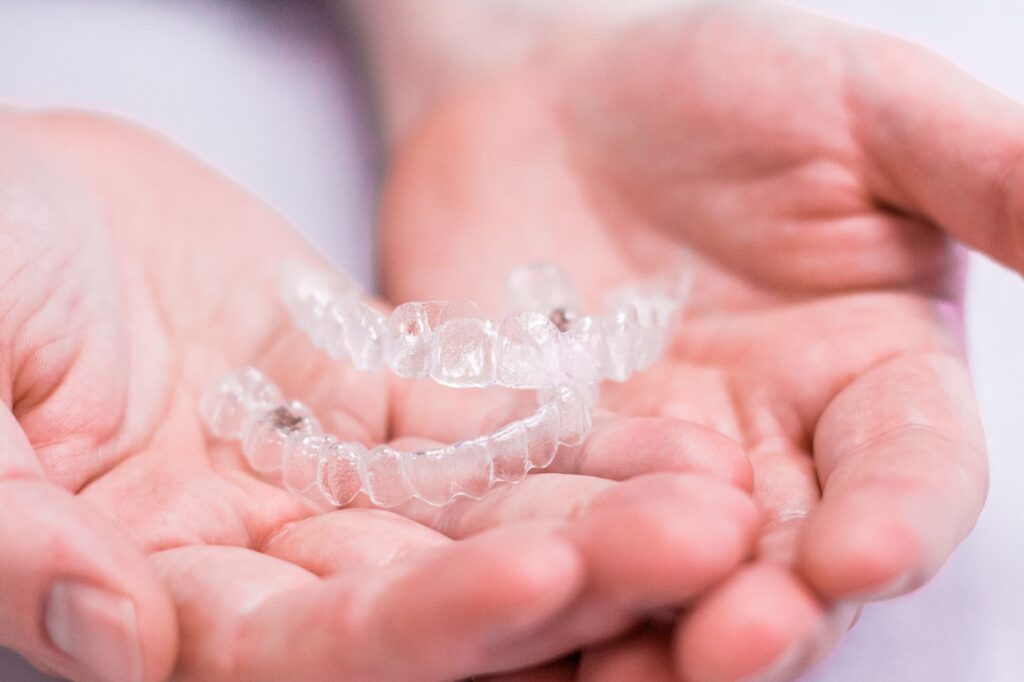
Invisalign attachments are small tooth-colored composite resin shapes bonded directly to your teeth so your aligners can grip and guide specific tooth movements. You may also hear them called SmartForce attachments or simply “bumps on teeth.” They’re temporary. Once your Invisalign treatment is complete, they come off.
Think of attachments as tiny anchors. Aligners alone slide over smooth tooth surfaces, which works well for simple movements. But many smiles need more precise force in specific directions. That’s where attachments come in. By bonding these shapes onto strategic teeth, your aligners have something to push or pull against, giving your orthodontist far more control over how each tooth moves.
At New England Orthodontic Specialists, Dr. Diana and Dr. Neil plan the exact size, shape and placement of every attachment during the digital treatment planning stage, long before your first set of aligners arrives. Each one is placed based on what your smile needs, not a one-size-fits-all approach.
How Invisalign Attachments Work
Aligners are excellent at tipping teeth and closing small spaces. But rotations, extrusions (pulling a tooth down), intrusions (pushing a tooth up) and true root movement are much harder with smooth plastic alone. Attachments solve that by giving aligners a three-dimensional surface to grip.
Here’s how the process typically works at our North Shore offices:
- Digital planning. Your scans are uploaded into ClinCheck software, where Dr. Diana and Dr. Neil map out every tooth movement. The software recommends attachment positions, and your board-certified orthodontist refines them based on clinical judgment.
- Template tray. Once your aligners arrive, your first set includes a clear placement template with small reservoirs where each attachment will go.
- Tooth prep. Your teeth are cleaned and a mild etching gel is applied to the exact spots where attachments will bond.
- Composite placement. Tooth-colored composite is placed in each reservoir, the template is seated over your teeth, and a special light cures the material in seconds.
- Template removal. The template peels away, leaving smooth, precisely shaped attachments bonded to your teeth.
The whole appointment is comfortable and usually takes under an hour. Attachments come in different shapes, such as rectangles, ovals and beveled wedges, and each shape is chosen for the specific movement a particular tooth needs.
Why Do You Need Invisalign Attachments?
Not every smile needs them, but for most people, attachments are what make Invisalign clear aligners a realistic alternative to metal braces. They expand what aligners can accomplish and often make the difference between a good result and a great one.
Here’s what attachments make possible:
- Predictable rotation of round teeth. Canines and premolars are shaped like cylinders, which makes them notoriously hard to rotate with plastic alone. Attachments give aligners the grip needed to turn these teeth into proper alignment.
- Vertical tooth movement. Extrusion and intrusion are two of the hardest movements in orthodontics. Attachments give aligners the mechanical advantage to move teeth up or down within the bone.
- True root control. Without attachments, aligners mostly tip the crown of a tooth. With them, your orthodontist can achieve bodily movement, meaning the root and crown move together.
- Better bite correction. Overbites, openbites and deep bites often require combinations of extrusion, intrusion and rotation. Attachments make all of these movements more predictable.
- Proper aligner seating. Attachments help your aligners stay fully seated on your teeth, which reduces tracking issues and the need for mid-treatment refinements.
- A wider range of treatable cases. Thanks to attachments, Invisalign can now treat cases that used to require metal braces, including extractions, significant crowding and complex bite work.
Attachments are a big reason clear aligners can deliver results that rival traditional braces for most patients.
Attachments vs. Buttons, Elastics and Braces Brackets
It’s easy to mix up the different “extras” that can show up during orthodontic treatment. Here’s a quick side-by-side look at how attachments compare to other common components.
| Feature | Invisalign Attachments | Buttons | Elastics | Braces Brackets |
|---|---|---|---|---|
| Material | Tooth-colored composite | Metal or clear composite | Medical-grade rubber | Metal or ceramic |
| Purpose | Grip for aligner-driven tooth movement | Anchor points for elastics | Connect upper and lower arches to correct bite | Hold archwires that move teeth |
| Visibility | Subtle, tooth-colored | Small but visible | Visible when smiling | Most visible option |
| How long worn | Length of Invisalign treatment | As needed during treatment | Days to months as prescribed | Full treatment duration |
| Removed by | Your orthodontist | Your orthodontist | You, between aligner changes | Your orthodontist |
Attachments are the least visible auxiliary of the group. They’re bonded flush to your teeth in a shade matched to your enamel, so even up close they’re hard to spot. Buttons are a little more noticeable because they stick out slightly to hold elastics. Both are routine parts of many Invisalign plans, and both come off cleanly when treatment is complete.
Do Attachments Affect the Cost of Invisalign?
Attachments are part of your Invisalign treatment plan, so they aren’t usually treated as a separate add-on. The cost of Invisalign depends on the complexity of your case and how long treatment takes, not on how many attachments you need.
At New England Orthodontic Specialists, your free consultation includes a clear explanation of your treatment plan and what’s covered. We accept all insurance plans and offer flexible payment plans built around your budget.
If you need refinement aligners near the end of treatment, your plan may include a few new attachments. Bring any cost questions to your consultation and we’ll walk through them with you.
Will You Need Attachments? Who Gets Them and Who Doesn’t
Most people starting Invisalign will need at least some attachments, though the exact number varies from person to person.
You’re more likely to need attachments if your case includes:
- Rotations of canines, premolars or other round teeth
- Deep bite or openbite correction
- Extractions as part of your treatment plan
- Significant crowding or spacing
- Vertical tooth movement (intrusion or extrusion)
- Complex bite relationships that need elastics
You may need fewer or no attachments if you have:
- Very mild crowding or spacing
- Minor relapse after previous orthodontic treatment
- A short, simple cosmetic case targeting just a few front teeth
Teens and adults often end up with similar numbers of attachments because the type of movement, not the patient’s age, drives the plan. Your board-certified orthodontist determines exact placement during the digital treatment plan review, and you’ll see a preview of where each attachment will go before your aligners are made.
At New England Orthodontic Specialists, Dr. Diana and Dr. Neil will walk you through your custom orthodontic treatment plan step by step so you know exactly what to expect, including whether your plan includes attachments and why.
Frequently Asked Questions About Invisalign Attachments
Do Invisalign attachments hurt?
Placement itself is comfortable. No needles, no drilling, no numbing required. You may feel mild pressure or tenderness for a day or two after your first aligner goes over the new attachments, which is a normal sign that your teeth are starting to move. Over-the-counter options can ease any soreness if needed.
Are Invisalign attachments visible?
Attachments are made of tooth-colored composite and shaded to blend with your enamel. From a conversational distance, most people won’t notice them. Up close, you may see small raised bumps on certain teeth, especially if light catches them. They’re still far less visible than metal braces or even clear braces brackets.
Do Invisalign attachments stain?
Yes, attachments can pick up stains if they’re frequently exposed to coffee, tea, red wine, dark sodas or tobacco smoke without your aligners in. Rinsing after meals, brushing well and wearing your aligners as directed all help keep your attachments looking fresh. Any surface staining comes off when your attachments are removed at the end of treatment.
How long do Invisalign attachments stay on?
Your attachments stay on for the full duration of active Invisalign treatment. For some cases, certain attachments are added or removed partway through as your plan progresses. Once treatment is complete, every attachment comes off in a single appointment.
What happens if an Invisalign attachment falls off?
Call our office. A dislodged attachment is a common, easy repair. Your orthodontist will rebond it quickly, usually at a short visit. Don’t try to glue it back yourself, and keep wearing your current aligner unless we tell you otherwise. Most tooth movement will continue even if one attachment is temporarily missing.
Can I remove Invisalign attachments myself?
No. Attachments are bonded with dental-grade composite and must be carefully polished off by a trained professional using specialized instruments. Trying to pry them off yourself can damage your enamel. At the end of treatment, your orthodontist will remove every attachment and polish your teeth smooth, usually in a single comfortable visit.
Ready to Start Your Smile Journey?
If you’re curious whether Invisalign clear aligners are right for you, or you want to know exactly what your custom orthodontic treatment plan would look like (attachments and all), we’d love to meet you. New England Orthodontic Specialists has been voted Best of Boston every year from 2018 to 2026, and as Diamond Invisalign Providers, Dr. Diana Esshaki and Dr. Neil Flückiger have the experience to make your treatment smooth, predictable and as subtle as possible.
New England Orthodontic Specialists welcomes your whole family at our five North Shore offices in Beverly, Topsfield, Hamilton, Salem and Lynn, MA. Call 978-922-3462 or book your free consultation online to get started. We can’t wait to meet you.